
We’re lucky to have legendary network scientist Professor Martin Rosvall visiting the group. He will give a talk on March 10th at 14:00 at DTU (full talk details below).
Martin is a network scientist and professor of physics with a focus on computational science at Umeå University, where he heads the Integrated Science Lab (IceLab) and its excellence center on modeling adaptive mechanisms in living systems under stress. His research develops mathematical models, algorithms, and visualizations that reveal structure and dynamics in complex systems—from information flow and citation networks to ecology and spreading processes.
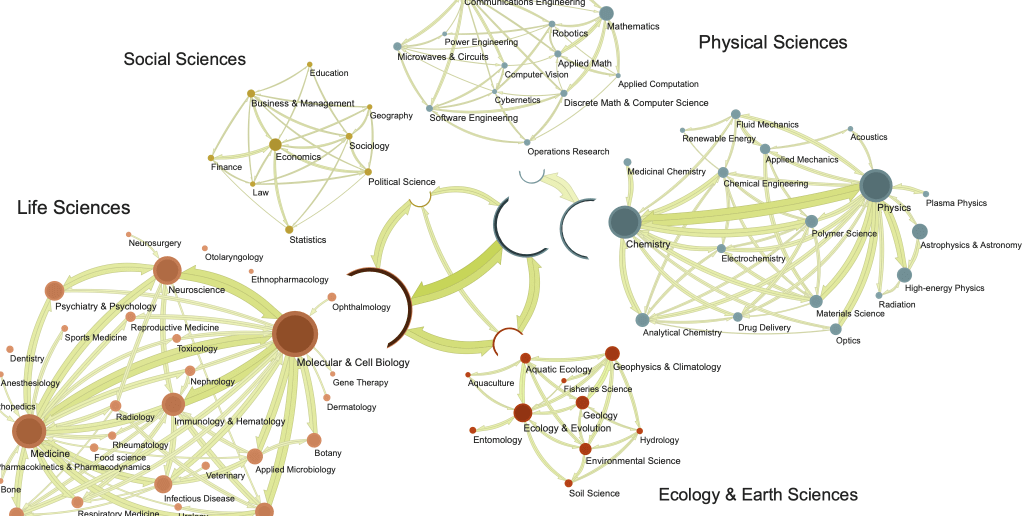
He is awesome in many dimensions: he’s a deep thinker, careful about amazing science communication, but probably best known (with Carl T. Bergstrom) for introducing the map equation framework for flow-based community detection in networks, and for the widely used Infomap approach built on those ideas. His work has been highly influential across network and data science, with publications and tools used broadly by researchers in many disciplines. Do not miss his talk!
The talk details are
- Time: March 10th, 14:00
- Place: DTU Compute Building 324, room 240
- Title: Predicting interactions in dynamic networks
- Abstract: Predicting future interactions or novel links in networks is an indispensable tool with many applications across diverse domains, including drug repurposing based on genetic networks, money laundering detection in financial systems, and recommendation systems using transactional data. Among the many techniques developed for link prediction, those leveraging the networks’ community structure have proven highly effective. For example, the recently proposed MapSim predicts links based on a similarity measure derived from the code structure of the map equation, an information-theoretic community-detection objective function that operates on network flows. The map equation benefits from Infomap, its fast optimization method widely regarded as one of the best network-clustering algorithms. However, we developed Infomap for static networks. While its stochastic greedy search algorithm excels at identifying reliable communities in network snapshots, Infomap cannot effectively integrate new data or adapt to smooth transitions over time in continuously evolving relational networks. This shortcoming raises a computational challenge: How can we equip the map equation framework with a computationally efficient optimization method to enable adaptive analysis of dynamic networks, leveraging evolving relational data to predict future interactions and uncover novel links in real time?
This is a great opportunity, don’t miss it!
 sune lehmann
Leave a comment