New paper: social roles in Honduran village networks
A quick post to celebrate a new paper out in PNAS: “Multiplex mapping of social roles in isolated Honduran village networks” [1]. It’s the second paper from a wonderful collaboration with Nikolaos Nakis, Morten Mørup and Nicholas Christakis, following our Nature Communications paper from earlier this year [2].
I wish I could claim credit for this awesome paper, but this is Nikolaos’s paper – he pulled all the threads together. It builds on a cool mathematical framework that he began developing with Morten years ago, and is connected to human behavior through Nicholas’s deep understanding of sociology and his incredible Honduran dataset. I was just lucky to be nearby and throw in a couple of comments here and there.
Nikolaos did his PhD here at DTU with Morten (and me) and is now at Nicholas’s Human Nature Lab at Yale. The Nature Communications and PNAS papers together are a pretty good advertisement for that particular career path.
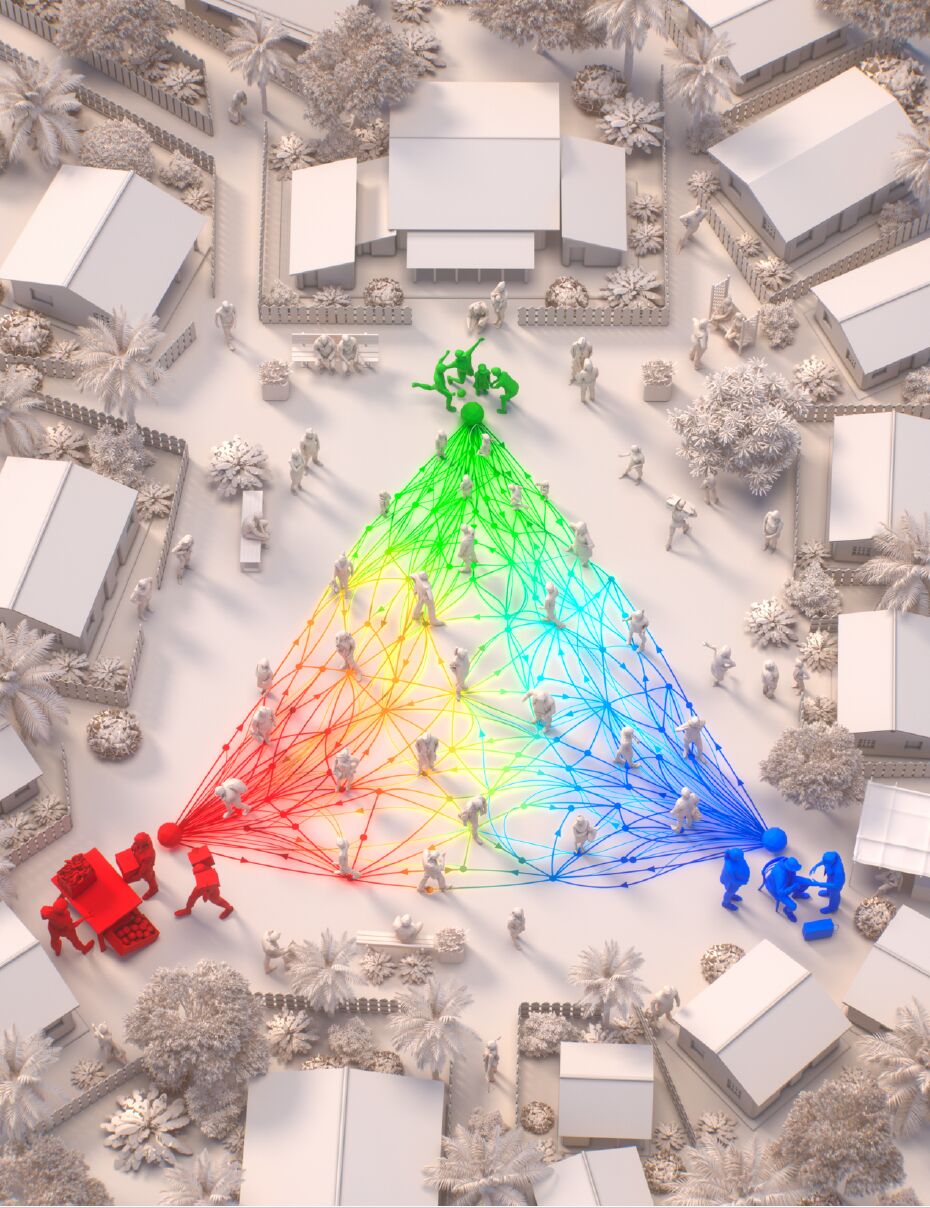
Here’s my brief summary of the paper. First of all, the paper builds on an amazing dataset. Across 176 isolated villages in western Honduras, the Human Nature Lab mapped the social networks of 23,378 people, and not just one network per village but several network layers: friendship, health-related support, and economic exchange. The Nature Communications paper introduced a model for finding the roles people play across layers like these. This paper uses the same modeling framework to focus on a real social-science question.
The key idea is that every tie has a direction. Some ties you send: you name someone as a friend, you go to someone for help. Others you receive: people name you, people come to you. So the paper splits each person’s role in two. The outgoing side captures how you spend your social effort. The incoming side captures how much others depend on you … or just how appealing you are as a contact.
The cool thing is that the two sides turn out to be organized very differently. The same ties, seen from the sender’s end and from the receiver’s end, tell different stories about people. Outgoing roles (what people do) are less tied to demographics and more strongly organized by geography than incoming roles. Another way of saying this is that people sharing a local environment tend to act socially in similar ways. Incoming roles (what others come to you for) shift with life stage, track socioeconomic position, and they have very little to do with geography.
And that’s it. Now we know a bit more about social networks! An amazing team, and a great collaboration.
References
[1] N. Nakis, S. Lehmann, M. Mørup, N. A. Christakis, “Multiplex mapping of social roles in isolated Honduran village networks,” PNAS 123(44), e2610932123 (2026). https://doi.org/10.1073/pnas.2610932123
[2] N. Nakis, S. Lehmann, N. A. Christakis, M. Mørup, “Modeling roles and trade-offs in multiplex networks,” Nature Communications 17 (2026). https://doi.org/10.1038/s41467-026-68896-1