What's gained and lost in reading AI text?
I keep reading takes on the ever-increasing amounts of AI slop online. Below I want to approach that topic from a different angle: What’s worth reading. We have a very limited amount of time on this planet, so what’s worth spending our precious time on?
My own personal philosophy can be roughly split up into two categories: fiction and non-fiction.
Fiction
This is the easy category (for me). And that’s because I have an extremist view here. I don’t want to read anything written by AI. Period.
To me, novels, poems, music, movies, etc. are about connecting with other human beings. Engaging with fiction is about entering a universe created by another person. And usually the point of that universe is to share something about being human, about our shared human experience. The joy, the pain, the fun, the hardship.
Right now, I can’t imagine a scenario where AI can be part of that.
I also want to stress that the viewpoint expressed above is my personal opinion. And I think that it’s perfectly possible for a reasonable person to disagree. Maybe you love crime novels, and only care about intricate plots … and maybe AI can just plot out things better than any human writer. Etc.
Anyway. Now on to the harder topic.
Non-fiction
This is a broad category, but for the purposes of this blog I mostly mean text books and the like. Basically, what I would call “tools for acquiring knowledge”.
Here, I’m much more open to AI. I’ve been using AI to quickly get back into theory I once learned and since forgot most of. Or to learn completely new things in a new and inspiring way.
In the old days, I’d usually skim the article on Wikipedia to get an overview, then find the relevant papers on Google Scholar and slowly get up to speed. Or sometimes, just dust off my old textbook and get back into it.
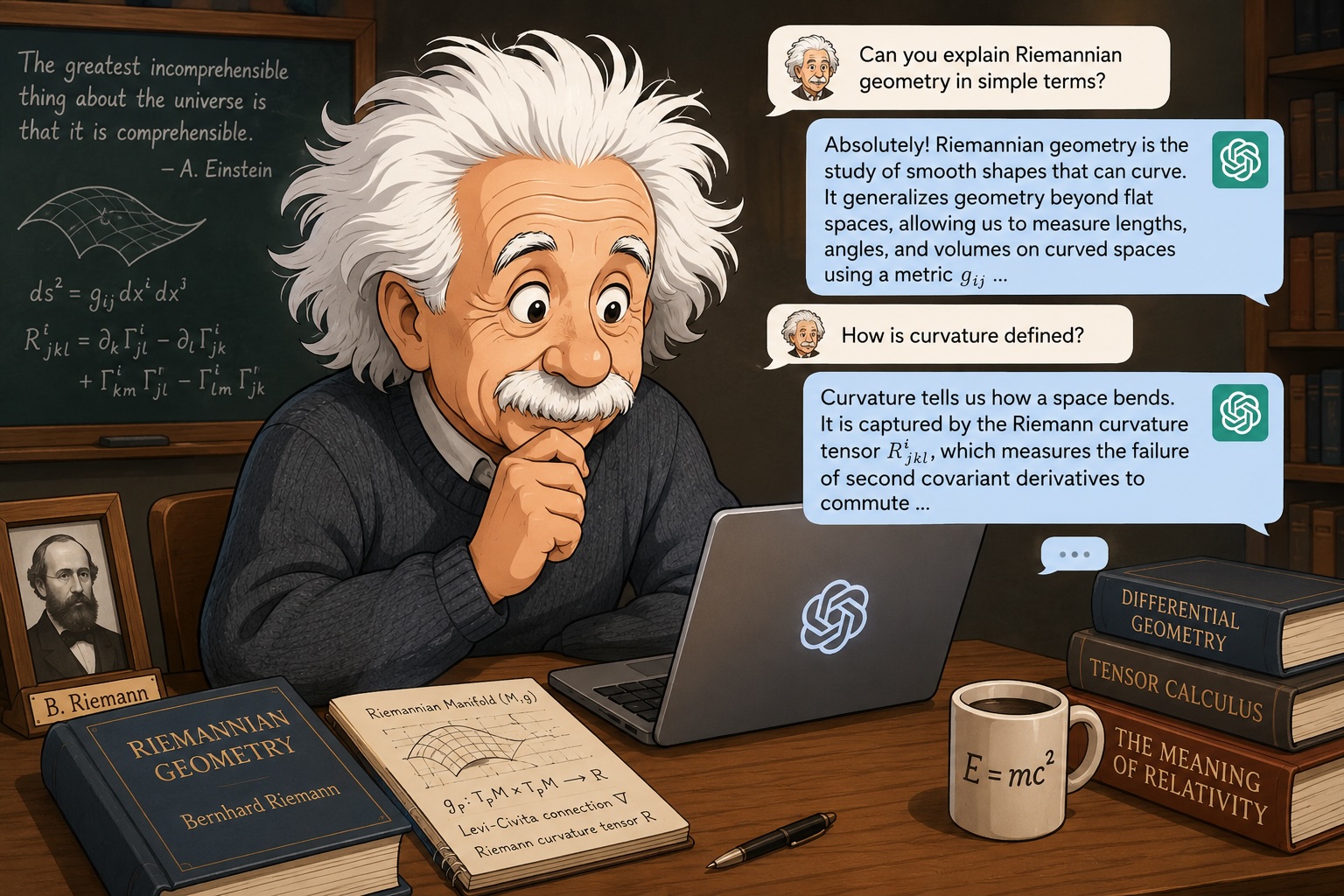
Nowadays, I often use an LLM instead. And the process becomes about prompting. I’ll ask something along the lines of “Explain [topic X] to me at the level of a university undergrad”. Then I’ll follow up with probing questions to the parts I’m interested in. It’s kind of awesome! It feels like I have a version of Wikipedia that can become infinitely detailed … that’ll take me right up to the cutting edge of research. And even give me the receipts if I need them. I kind of love it!
But the convenience of the LLM comes at a cost.
- Firstly, I’ve noticed that I tend to forget the knowledge I’ve acquired the new way. Maybe I’m imagining things, but I suspect that there’s something about the much more cognitively demanding situation of wrestling knowledge out of scientific papers that makes that knowledge stick around in my head for longer.
- Secondly, it’s important not to forget that the LLMs are undermining open systems of knowledge like Wikipedia. By using them, we cast a vote against keeping Wikipedia active and vibrant. And as a subpoint, let’s not forget the extreme cost of training the models, the copyright infringement that went into creating them, etc. Every time we use an LLM, we’re also supporting the extractive systems that made them possible.
So even if I love using LLMs to learn new things, it’s not without a sense of unease.
Everything in between
But it’s not all poetry vs generic textbooks. There’s lots of things in between. There’s lots of non-fiction where the author’s voice is what makes it interesting. Michael Lewis is such a great writer that I’ll read anything he writes. And that’s because I want to hear his angle on any topic. If he’s interested in a topic, I assume there’s something to be excited about, even if I’d considered the topic boring up to that point. And there are many people like that.
So hopefully humans still have a role in the non-fiction category too. I feel like I’m connecting with my favorite non-fiction writers in a way that’s very related to the author of a novel or a poem.
Wrapping up
I’m not the only person who has reflected on AI and art. AI and writing. Perhaps my favorite thinker on the topic is Nick Cave, who has discussed it on his Red Hand Files, a newsletter where Cave answers questions from his fans.
In Issue #359 he writes the following:
We weep, laugh, and dance not just because of the song’s rhythm or melody, but because in the music we recognise the struggle intrinsic to the act of creation and the sheer life-affirming audacity of creativity itself, that most elemental of human impulses. These songs speak in a language of inspiration and hope, telling us that we can overcome the many troubles and disillusions we face. Through their very existence, they show us that beauty and goodness can prevail.
So, as a songwriter, David, I find myself despairing over the rise of AI song generators. It’s not that they aren’t good, in fact they are – or soon will be – too good. Before long, they will be able to produce songs indistinguishable from those created by humans. And this is what grieves me. They will be identical in presentation, perhaps even superior, but entirely devoid of soul, cynically undermining the need for matters of the spirit, the sacred, the divine. [My emphasis]
P.S. If you want to read more Nick Cave and AI, I also recommend the following two posts: